
Zcash Surges 130% in 30 Days While Bitcoin Retreats on Fed Hikes
A Privacy Token Defies the Selloff
While Bitcoin slipped under pressure from the Federal Reserve’s latest rate hike and signals of further tightening ahead, Zcash carved out a dramatically different path. The privacy-focused token climbed roughly 6% on the day and extended a monthly run that has now reached 130% – a gain that stands apart from nearly everything else moving in crypto markets right now.
Zcash is trading near its all-time highs from 2016.
That detail matters. Most assets that spike 130% in a month are still sitting well below their historical peaks. Zcash is not. The token is operating at price levels last seen during its initial launch era, when it debuted with an extraordinary premium before gradually fading into the background of a market increasingly dominated by Ethereum and a constellation of newer smart-contract platforms. The fact that it has returned to that territory – during a period when the Fed is actively tightening and major coins are sliding – raises genuine questions about what is driving the demand.
What the Fed Decision Did to the Rest of the Market
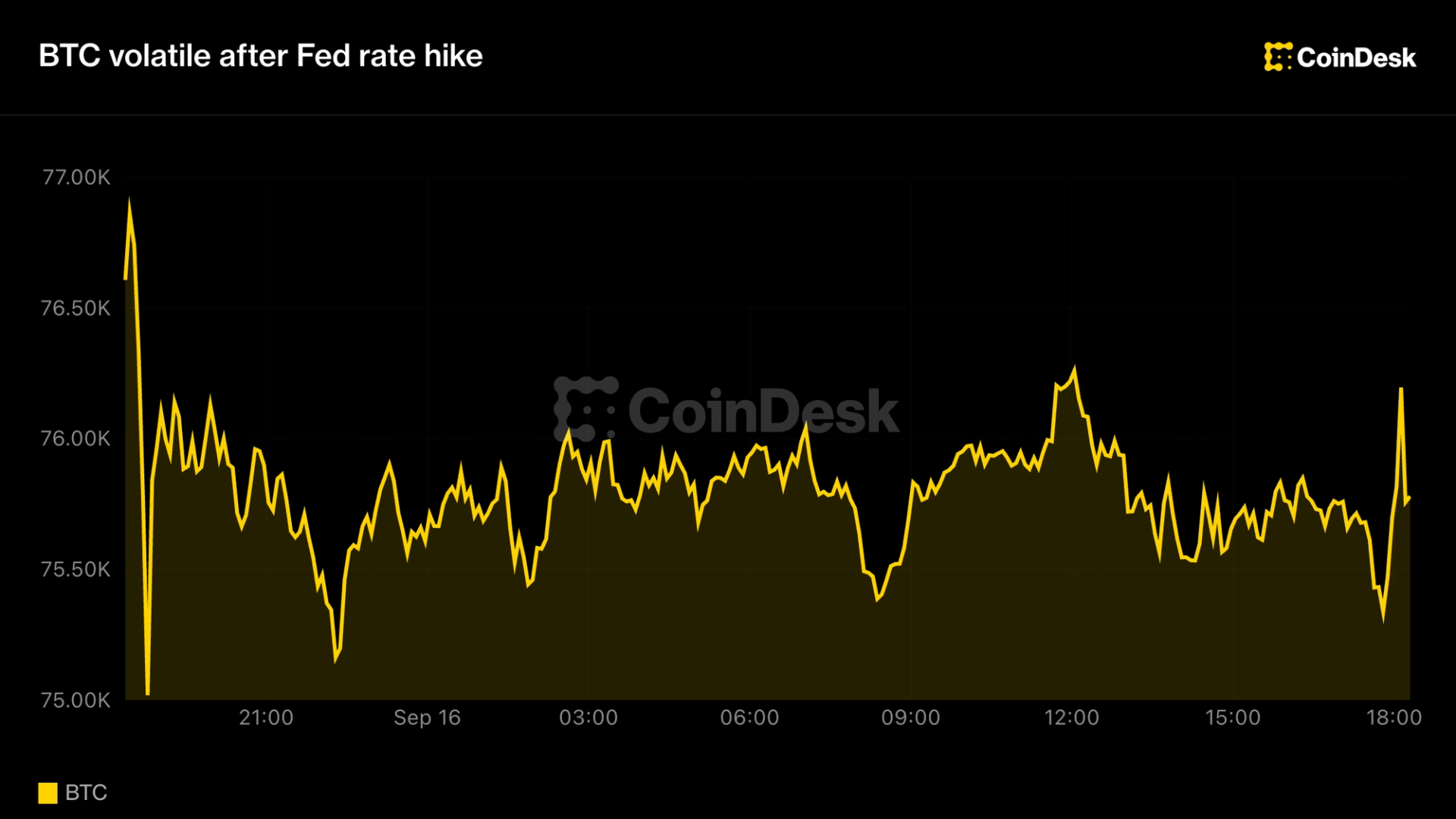
The Federal Reserve hiked rates and indicated that additional increases remain on the table. For Bitcoin and the broader market, the reaction was straightforward: prices fell. Rate hikes raise the cost of holding risk assets, and cryptocurrency – still treated by institutional allocators as a high-beta, speculative category – tends to absorb that pressure quickly. Bitcoin’s slide following the announcement followed a pattern that has repeated itself multiple times over the past year of tightening cycles.
The “majors” as a category moved lower ahead of the decision, with traders reducing exposure before the announcement rather than waiting to react. That kind of pre-decision selling reflects how much more institutionalized crypto markets have become – participants now position around Fed calendar events the same way equity traders do, hedging risk before the statement drops rather than scrambling afterward. The result is that price movement often begins hours before the actual announcement, which flattens the immediate post-decision reaction.
Against that backdrop, Zcash’s 6% daily gain was not a small divergence. It was a categorical rejection of the direction everything else was moving. Whether that divergence is sustainable – or whether it is the kind of vertical move that collapses once momentum traders exit – is the central question hanging over the token right now.
Privacy Tokens and the 2016 Benchmark
Zcash launched in late 2016 with enormous hype around its zero-knowledge cryptography, a technology that allows transactions to be verified without revealing sender, receiver, or amount. In its earliest days, the token traded at prices that reflected speculative mania more than any realistic assessment of adoption – some early trades cleared at values equivalent to several Bitcoin each. Those prices collapsed quickly, and Zcash spent years well below its launch-era highs even as the broader crypto market went through multiple bull cycles. Returning to those levels now, nearly a decade later, means the token has effectively completed a full round trip that most privacy coins never managed.
Privacy tokens as a category occupy a complicated space. Regulatory pressure on exchanges has led to delistings – Monero, for instance, was removed from several major platforms in European and U.S. markets over compliance concerns tied to anti-money-laundering frameworks. Zcash has fared somewhat better in that regard, partly because its shielded transactions are optional rather than mandatory, giving exchanges and regulators a technical argument that the transparent transaction layer remains auditable. That distinction has allowed it to maintain listings that some competitors lost.
A 130% monthly move, however, almost never traces back to a single fundamental catalyst. Price action at that magnitude is typically a product of thin liquidity meeting concentrated buying – a structure where a relatively small amount of capital can push prices dramatically because there are not enough sellers at each level to absorb the demand. Whether the move reflects genuine renewed interest in privacy infrastructure or a shorter-term positioning trade is not clear from price data alone.
What Comes Next Is Not Obvious
The Fed’s suggestion that more rate hikes are coming puts the broader crypto market on a familiar defensive footing. Bitcoin’s retreat is the headline, but the more durable story may be how assets like Zcash – with specific technical identities rather than general store-of-value narratives – behave during extended tightening periods. If macro pressure keeps Bitcoin and Ethereum compressed, capital does not simply leave the market; some portion of it rotates into smaller tokens where perceived upside is larger. That rotation dynamic can sustain moves like Zcash’s for longer than fundamentals would predict. It can also unwind faster than anyone expects, particularly if Bitcoin stabilizes and pulls attention back to the larger caps. Zcash at 2016 highs, with the Fed still hiking, is either the setup for a continuation or the exact moment a trade gets crowded – and the difference between those two outcomes is, at this point, a matter of timing that no one has reliably figured out.
Comments are closed, but trackbacks and pingbacks are open.