
Aave Eyes GHO Borrow Rate Hike After Stablecoin Slips Off Dollar Peg
GHO Holds a Discount as Governance Moves to Act
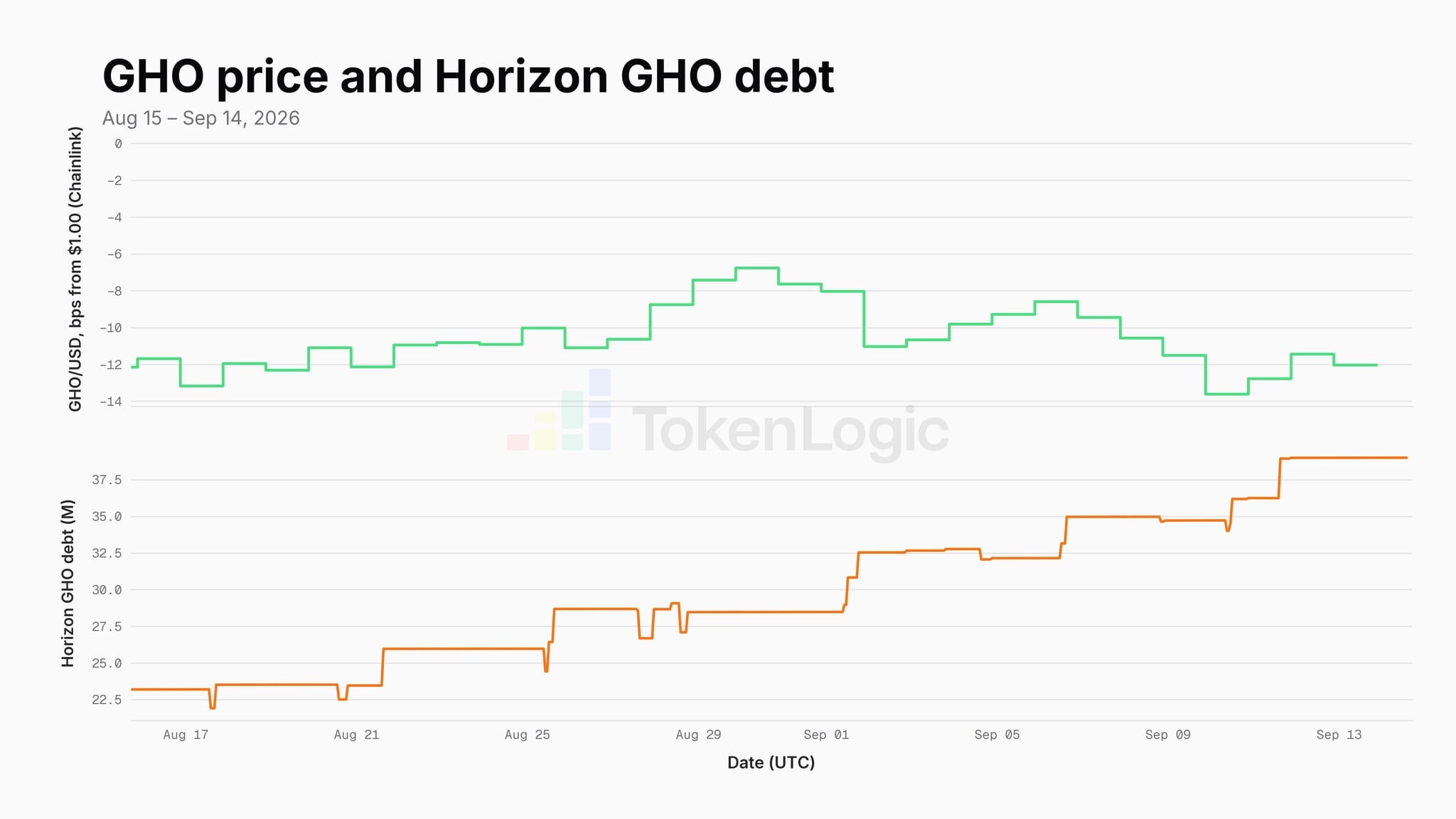
Aave’s governance forum has published a September 14 parameter update proposing changes to GHO’s borrowing rate on its Horizon market, alongside Stability Module fee adjustments across Ethereum, Monad, and Arbitrum – the direct response to GHO trading between 6.7 and 13.6 basis points below its $1 target for 30 consecutive days.

How Horizon Growth Put Pressure on the Peg
GHO debt on Horizon climbed from 23.2 million to 39.0 million during the 30-day window referenced in the proposal – a 68% increase. That expansion did not happen in isolation. Aave’s protocol stewards identified leveraged borrowing strategies as a contributing factor: users mint GHO, deploy it in additional leveraged positions, and then sell the borrowed tokens into competing stablecoins. The mechanics create a cycle where new GHO supply enters the market alongside immediate sell pressure.
Independent data from Aavescan, pulled as of September 12, confirmed the 39.0 million GHO figure on Horizon with the market’s borrowing rate sitting at 3.00%. That corroborates the debt level and rate cited in the governance update, grounding the proposal in observable on-chain conditions rather than projections.
The 12-basis-point discount recorded at the proposal’s latest observation is not catastrophic in dollar terms. For someone holding a single GHO token, the gap amounts to fractions of a cent. But for a stablecoin whose entire design premise is a $1 price, even a persistent 12-basis-point shortfall signals that market dynamics are working against the peg – and that existing rate settings are not counteracting them.
Aave’s proposed fix on the borrowing side is a 25-basis-point increase to Horizon’s base rate, moving it from 3.00% to 3.25%. That adjustment raises the cost of the looping strategies described in the proposal without eliminating Horizon’s pricing advantage over Aave’s other GHO markets. After the increase, Horizon would still sit below the 3.84% base rate on Prime and the 4.25% rate on Core – maintaining a rate hierarchy while adding marginal friction to the strategies driving GHO’s discount.
Stability Module Fees: Diverging Paths for USDC and USDT
The borrowing rate change alone does not exhaust Aave’s proposed response. The governance update also targets the Stability Module – the mechanism through which GHO can be exchanged for other stablecoins – by reshaping redemption fees across networks in ways that cut in opposite directions depending on the asset involved.
On Ethereum, Monad, and Arbitrum, the USDC redemption fee would rise to 15 basis points from 10 basis points. That makes the USDC exit route incrementally more expensive on every network where the change applies. The Ethereum USDT route moves the other way: its fee would drop to 10 basis points from 15 basis points, making it cheaper to redeem GHO through USDT on that chain specifically.
Rather than a blanket adjustment, the proposal deliberately creates asymmetry between routes. Making USDC redemptions more expensive discourages one of the more common paths out of GHO while making the USDT route on Ethereum comparatively attractive. The intent is to reshape where redemption activity flows, not simply to slow it across the board.
Monad receives an additional change under the same proposal: its GHO reserve limit would double to 50 million from 25 million. That capacity expansion runs parallel to the fee increases rather than against them – it accommodates growth while the fee adjustments attempt to moderate the sell dynamics that growth has historically triggered.
Taken together, the rate hike and the Stability Module changes address the two levers most accessible within Aave’s existing market structure. Raising the cost of borrowing on Horizon targets new debt formation and the leveraged strategies tied to it. Adjusting redemption fees targets what happens after GHO is borrowed – the paths users take when converting it to other stablecoins. Neither change is presented in the proposal as sufficient on its own, and the governance post frames them explicitly as paired interventions rather than sequential fallbacks.
What the Proposal Leaves Open
The governance forum post records a 12-basis-point discount at its September 14 observation, a figure that sits near the upper end of the 6.7-to-13.6 basis point range documented across the preceding month. Whether a 25-basis-point rate increase and restructured Stability Module fees can narrow that gap depends on how sensitive the looping strategies are to marginal cost increases – something the proposal does not quantify.
Horizon’s rate would still be meaningfully lower than Prime and Core after the adjustment. If the spread between Horizon and those other markets remains wide enough to sustain leveraged borrowing at scale, the 68% debt growth seen over the past 30 days could continue even with a slightly higher entry cost. The proposal sets a direction; the on-chain response from borrowers will determine whether 3.25% carries enough weight to shift it.
Comments are closed, but trackbacks and pingbacks are open.