
Fed Hikes Rates for First Time Since July 2023
The Fed Moves Again
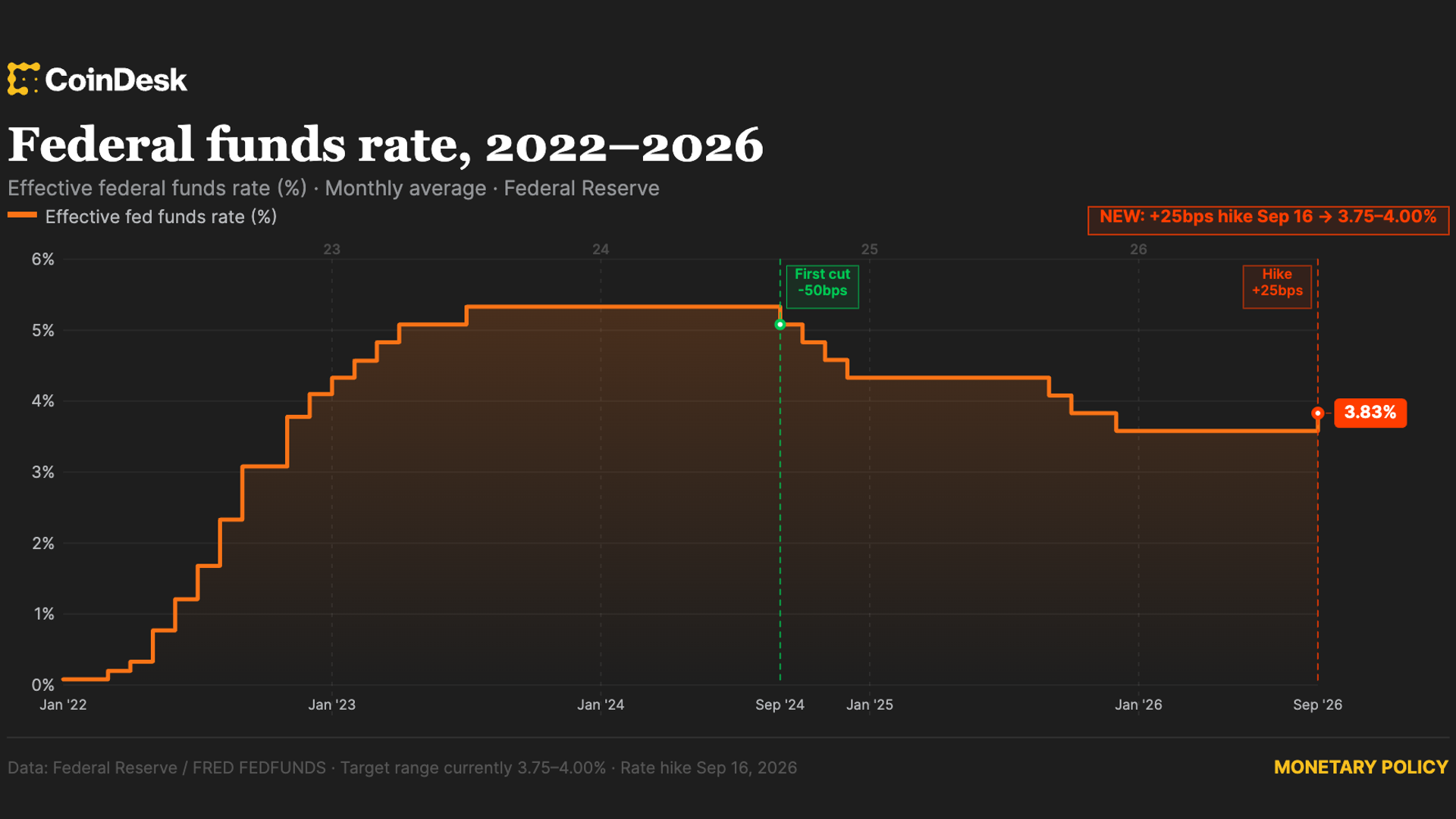
The Federal Reserve raised its benchmark interest rate by 25 basis points on September 16, 2026, pushing the federal funds rate target range to 3.75%-4.0% – the first hike the central bank has delivered since July 2023.
What the Rate Decision Actually Means
More than three years passed between the Fed’s last tightening cycle and this move. During that stretch, crypto markets absorbed a prolonged period of rate cuts and holds, conditions that historically reduce the opportunity cost of holding speculative assets. A return to rate hikes flips that dynamic. Borrowing gets more expensive, risk appetite contracts at the institutional level, and assets without yield – bitcoin, ether, altcoins – face renewed pressure to justify their place in a portfolio.
The 25-basis-point increment is modest by the standards of 2022 and 2023, when the Fed was delivering 50- and 75-point moves in rapid succession. But the signal matters as much as the size. This hike confirms that the Fed sees current inflation or economic overheating as serious enough to restart the tightening machine after a 14-month pause, and that assessment alone carries weight in how traders position across all risk assets.
At 3.75%-4.0%, the fed funds rate now sits in territory that competes directly with the returns available in short-duration Treasuries and money market funds. That competition has a measurable effect on crypto specifically, because retail and institutional capital flows shift toward lower-risk yield when the spread between a 4% T-bill and a speculative digital asset narrows. The calculation investors make is straightforward: a guaranteed 3.9% versus an uncertain 15% looks very different from a guaranteed 0.5% versus an uncertain 15%.
Crypto markets had largely priced in this move heading into the September meeting. Whether that pre-positioning holds or unwravels depends on what the Fed signals about the pace of future hikes – and whether this is a single corrective move or the start of a new tightening sequence.
Crypto’s Complicated Relationship With Rate Cycles
The period between July 2023 and September 2026 was not a simple bull run for digital assets. Bitcoin and the broader crypto market moved through multiple distinct phases – recovery rallies, regulatory headwinds, institutional adoption waves, and sharp corrections – none of which mapped cleanly onto the Fed’s rate posture. That complexity is worth noting, because the assumption that low rates automatically produce crypto gains, or that hikes automatically kill them, has been repeatedly undermined by market behavior.
What rate hikes do more predictably is tighten conditions for crypto companies themselves. Venture capital funding becomes more selective when the cost of capital rises. Crypto startups that relied on low-rate environments to raise at stretched valuations find subsequent rounds harder to close. Exchanges and trading platforms that expanded headcount and infrastructure during looser conditions start making different calculations about growth spending. The 2022-2023 rate cycle produced exactly that kind of industry contraction, and the memory is fresh enough among operators that this hike will prompt real internal reassessments.
Stablecoin dynamics also shift in a higher-rate environment. When the Fed funds rate climbs, the yield that stablecoin issuers earn on their Treasury reserve holdings increases. That was a significant revenue driver for issuers like Tether and Circle during the last tightening cycle, and it will be again if the rate holds or continues climbing. The 3.75%-4.0% range applied to tens of billions in Treasury holdings produces substantial income – income that accrues to issuers, not to stablecoin holders, a structural tension that periodically resurfaces as a criticism of the current stablecoin model.
For traders operating in crypto derivatives markets, a Fed hike introduces a recalibration of funding rates, carry trades, and basis positions. Perpetual futures funding rates across major exchanges tend to soften when spot price momentum stalls on macro news. If the hike triggers even a short-term pullback in spot bitcoin or ether prices, long-heavy open interest positions face liquidation pressure, and that cascade effect can amplify the initial move well beyond what the fundamental rate change would otherwise justify.
The longer-term question for crypto investors is whether this hike represents the Fed making a one-time correction – responding to a specific data point – or whether it opens the door to a sequence of moves that brings rates meaningfully higher than 4%. A single 25-basis-point hike at this stage of the cycle is manageable. A return to the kind of aggressive multi-meeting tightening seen in 2022 would be a different challenge entirely, particularly for early-stage crypto projects where valuation assumptions depend heavily on long-duration risk appetite staying intact.
What Comes Next
The Fed’s next scheduled meeting will be the first test of whether September 16’s move was a standalone decision or the opening of a new chapter. Dot plot projections, inflation data, and employment figures between now and that meeting will all feed into how aggressively traders position ahead of the next announcement. A single hike to 3.75%-4.0% is not in itself a structural threat to crypto markets – but the Fed has made clear that the pause that defined the last 14 months is over.
Bitcoin’s price at the moment the Fed’s statement dropped, the immediate reaction in altcoin markets, and the behavior of crypto equities like Coinbase and MicroStrategy in after-hours trading will all offer early reads on how seriously the market is taking the shift.

The Fed last raised rates in July 2023. It took 14 months to cut, and then more than another year before hiking again. Whether the institution moves at that same deliberate pace going forward – or whether September 2026 turns out to be the start of something faster – is the question now sitting underneath every open position in the crypto market.
Comments are closed, but trackbacks and pingbacks are open.