
Stablecoin Payments Hit $527B While Supply Lags at $303B
Payment Activity Races Ahead of Outstanding Supply
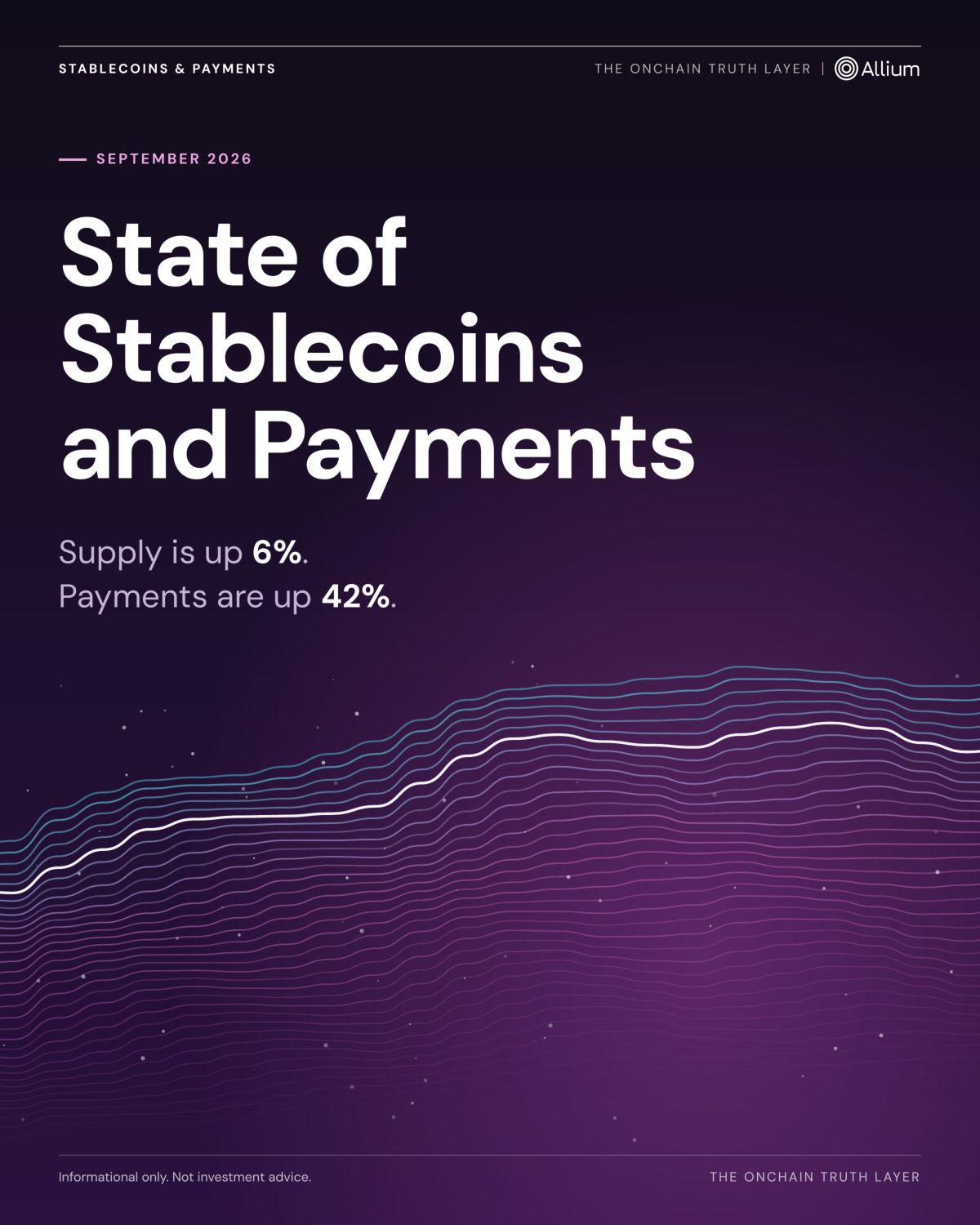
Stablecoin supply reached $303 billion in August 2026, a 6% year-over-year increase – but the more striking figure sits in payment activity, where identified stablecoin payments climbed between $401 billion and $527 billion across the first eight months of 2026, according to data analytics firm Allium.

What the Numbers Actually Measure
The 42% to 63% year-over-year growth in identified payments is notably faster than the 6% expansion in outstanding supply, and the gap between the two metrics carries meaning for how regulators might assess stablecoin utility. Supply growth reflects new issuance minus redemptions; payment volume reflects how aggressively existing supply circulates. When payments grow at ten times the rate of supply, that signals rising velocity – stablecoins completing more transactions per unit issued.
Allium draws a sharp line between identified payment activity and total stablecoin transfer volume. Total transfers from January to August 2026 reached $85 trillion – a figure that includes internal wallet movements, exchange settlement flows, DeFi rebalancing, and similar activity that does not constitute a commercial payment. The $401 billion to $527 billion payment estimate strips much of that noise away, isolating transactions that resemble what regulators and central banks typically define as payment events.
The range in Allium’s payment estimate – a $126 billion spread – reflects the difficulty of classifying on-chain activity with certainty. That classification problem is itself a regulatory challenge. The U.S. GENIUS Act, the EU’s MiCA framework, and proposed stablecoin regimes in the UK and Singapore all hinge on definitional questions: what qualifies as a payment, who counts as a payment service provider, and which stablecoin uses trigger licensing requirements. Allium’s methodology, which attempts to separate payment receipts from broader transfer noise, illustrates exactly how imprecise those boundaries remain in practice.
Tether and Circle together accounted for 85% of the $303 billion total supply in August 2026. That concentration matters to regulators who have long flagged systemic risk concerns about a market dominated by two private issuers. Allium also recorded $89 billion of stablecoin supply held on exchanges and $26 billion held in DeFi protocols – balances that fall under different regulatory treatment depending on jurisdiction, since exchange-held assets typically face custody and reserve requirements while DeFi-held supply often exists outside licensed intermediary frameworks entirely.
Businesses at the Center of Stablecoin Flow
Allium’s breakdown of payment receipts places businesses at the receiving end of 58% to 64% of all identified stablecoin payments, with business-to-business transfers forming the single largest payment lane. That concentration of commercial activity is significant from a compliance standpoint. B2B payment flows implicate know-your-business obligations, sanctions screening, and in some jurisdictions, specific licensing for commercial money transmission – requirements that differ substantially from those applied to retail or consumer-facing transactions.
Regulatory frameworks drafted primarily with retail stablecoin use in mind may be structurally mismatched with how the market is actually operating. If businesses account for the majority of payment volume, then the enforcement pressure and compliance burden falls predominantly on commercial entities executing treasury operations, cross-border supplier payments, and trade settlement – not on individual consumers making peer-to-peer transfers. That has direct implications for how financial intelligence units and banking supervisors should prioritize examination resources.
Cross-border stablecoin payments grew 64% in 2025, against 9% growth for conventional fiat correspondent banking rails over the same period. The speed differential between those two tracks reflects both the technical advantages of blockchain settlement and the relative absence of friction from the correspondent banking system’s compliance layering – intermediary banks, nostro account delays, and SWIFT message handling that slows fiat cross-border transfers. Stablecoins bypass most of that infrastructure, which is precisely why anti-money-laundering authorities in multiple jurisdictions have moved to extend travel rule requirements to stablecoin transactions.
Allium’s 2026 report does not provide a comparable cross-border growth rate for 2026 specifically, so whether that 64% pace accelerated, moderated, or held steady through August 2026 remains unknown from the supplied data. The absence of a 2026 cross-border breakdown is notable given how prominently cross-border settlement features in ongoing regulatory debates – the Financial Action Task Force’s guidance on virtual assets explicitly targets cross-border flows as the highest-risk payment corridor.
B2B payment corridors, identified by Allium as the dominant lane, are the same corridors where regulators have struggled most to apply existing frameworks. Correspondent banking rules, which govern how banks move money across borders for corporate clients, were designed around licensed intermediaries with identifiable counterparties. Stablecoin B2B flows often replace that chain with smart contract execution between wallet addresses – creating a compliance gap that neither the FATF’s travel rule guidance nor most national payment regulations fully closes. Allium’s data does not indicate what share of the B2B payment volume is cross-border versus domestic, which limits how precisely that gap can be sized.
Supply Concentration and Reserve Oversight
The 85% market share held by Tether and Circle creates a regulatory focal point that legislators in multiple jurisdictions have explicitly addressed. MiCA, which took full effect in 2024, imposes reserve requirements, redemption rights, and transaction volume caps on stablecoin issuers operating in the EU – and Tether’s legal status under that regime has been a recurring point of friction with European regulators. Circle, by contrast, has pursued regulatory engagement more aggressively, filing for a bank charter in the United States and obtaining an Electronic Money Institution license in France. The $303 billion supply figure – dominated by those two issuers – means that any regulatory action targeting either entity would move the market materially.

The $26 billion held in DeFi protocols sits in a category that most existing stablecoin regulations have not yet addressed with any precision. DeFi liquidity pools, lending protocols, and automated market makers hold stablecoins without any licensed custodian in the chain, making standard reserve audits and redemption-right enforcement difficult to execute. Whether the 2026 legislative sessions in the U.S. Congress – where the GENIUS Act remains in active negotiation – will produce language specific enough to cover DeFi-held stablecoin supply is one of the live questions that Allium’s August 2026 numbers put back into focus.
Comments are closed, but trackbacks and pingbacks are open.