
Senate Kills Clarity Act, Bitcoin ETFs Bleed $450 Million
A Legislative Collapse With an Immediate Price Tag
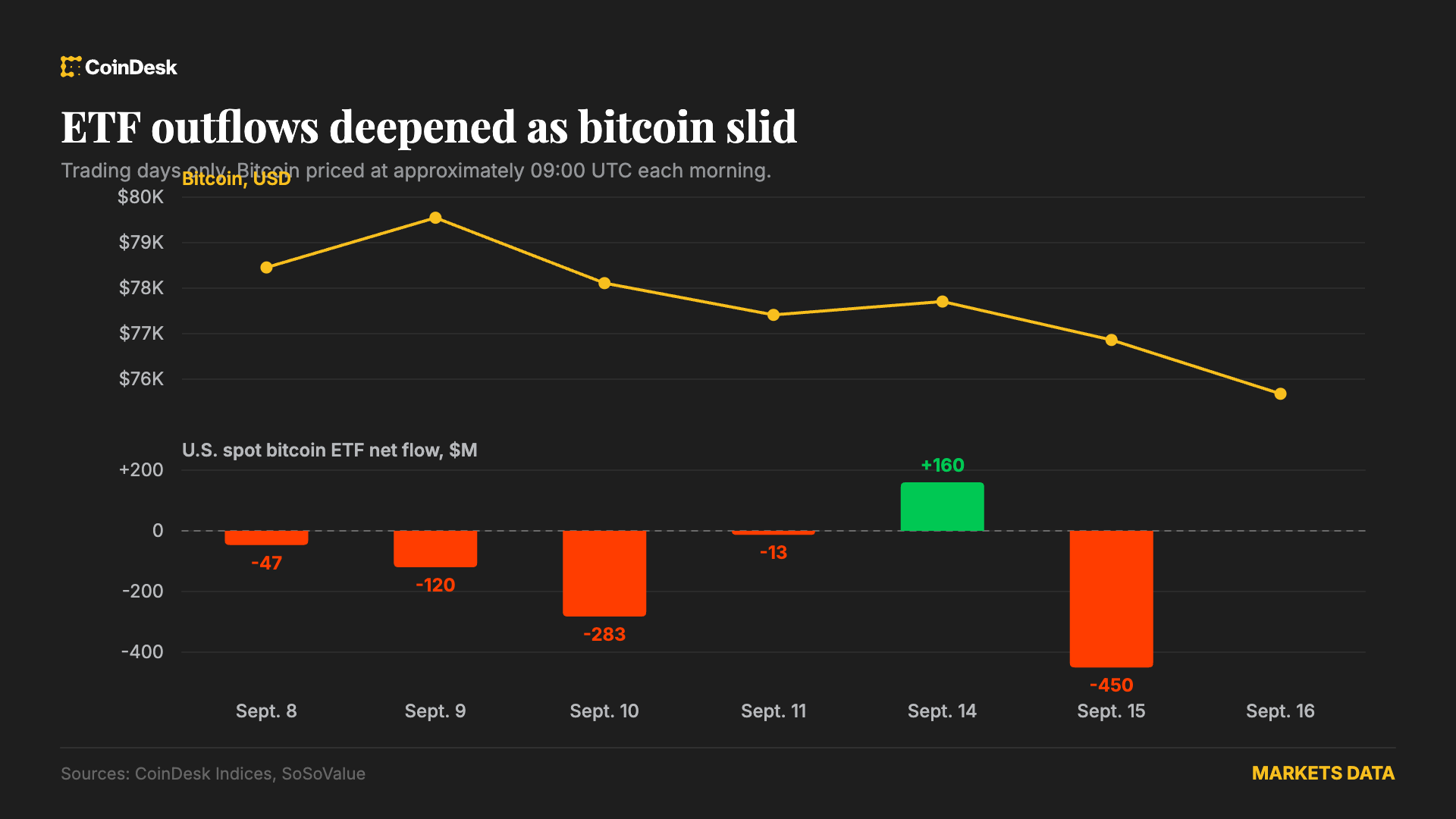
U.S. spot bitcoin ETFs recorded $450 million in outflows – the steepest single-day exit since June – after the Senate failed to advance the Clarity Act, triggering a sharp selloff across regulatory-sensitive digital assets.
What the Clarity Act Was Supposed to Do
The Clarity Act had been positioned as the most direct attempt yet by Congress to draw a legal boundary between securities and commodities in the digital asset space. For months, its potential passage shaped how institutional desks sized their exposure to tokens whose regulatory classification remained genuinely ambiguous. The bill’s failure in the Senate didn’t just stall a policy timeline – it removed a known catalyst that a portion of the market had been pricing in.
Regulatory clarity, or the expectation of it, has a measurable effect on how money moves into crypto. Tokens that sit in legal gray zones – where the question of SEC versus CFTC jurisdiction has never been formally settled – carry a discount that reflects that uncertainty. When the Clarity Act looked viable, that discount narrowed. When the Senate couldn’t advance it, the discount came back fast.
The $450 million outflow figure captures institutional and retail money exiting through the ETF wrapper specifically. It doesn’t capture direct wallet selling, futures positioning changes, or the broader altcoin drawdowns that followed the Senate vote. The ETF number alone, though, is significant: it’s the largest single-session exit since June, a month that itself saw considerable volatility.
ETF outflows at this scale also carry a secondary signal. Spot bitcoin ETFs were approved in the U.S. after years of legal battles, and their launch represented a structural shift in how mainstream capital could access bitcoin exposure. When those products see $450 million leave in a single session tied to a regulatory event, it indicates that at least some of that capital remains sensitive to U.S. policy developments – not just bitcoin’s price action.
The Senate Vote and Its Market Mechanics
The Senate’s inability to advance the Clarity Act was the direct trigger. The word “advance” matters here – the bill didn’t die in a final vote, it failed to clear the procedural threshold required to move forward. That distinction affects how the market interprets what comes next: a bill that fails procedurally can theoretically be revived; one that fails a final vote carries more finality. Even so, the market’s reaction treated the failure as a meaningful setback rather than a temporary delay.
Regulatory-sensitive tokens sold off sharply in the aftermath. These are assets whose market value is tied, at least in part, to assumptions about how U.S. regulators will eventually classify and treat them. When the legislative framework that might have resolved those classifications stalls, the uncertainty premium on those tokens rises – and prices fall to reflect it.

Bitcoin itself sits in a different regulatory position than most altcoins. The SEC has, in practice, treated bitcoin as a commodity, which is part of why spot bitcoin ETFs were eventually approved. The ETF outflows suggest that even bitcoin-focused products weren’t immune to the sentiment shock that followed the Senate’s move – investors who hold bitcoin through regulated wrappers appear responsive to legislative news even when bitcoin’s own classification isn’t directly at stake.
The timing matters too. September has historically been a difficult month for crypto markets, and the Senate failure landed at a point when the market was already navigating a mix of macro pressures. A $450 million outflow during a month with lighter trading volume has more price impact than the same number during a high-liquidity period. The sharp drops in regulatory-sensitive tokens reflect that dynamic – sellers had less buying interest to absorb their exits. For context on how macro pressures have been stacking up against crypto positions this season, the $600M liquidation event tied to FOMC rate speculation earlier this cycle illustrated how quickly institutional positioning can unwind when external conditions shift.
There’s also the question of what the Clarity Act’s failure means for the next legislative cycle. Congressional calendars are finite, and bills that don’t advance in one session face real obstacles to being reintroduced and gaining traction quickly. The crypto industry had lobbied heavily for the bill, and its stall represents a delay measured not in weeks but potentially in years before a comparable framework reaches the same legislative stage.
What Investors Are Watching Now
With the Clarity Act off the table for the foreseeable future, the regulatory landscape reverts to its pre-bill state: enforcement actions, court rulings, and agency-level guidance as the primary mechanisms shaping how digital assets are treated under U.S. law. That’s a slower, less predictable process than legislation – and the $450 million that left bitcoin ETFs on the day of the Senate vote reflects how the market prices that uncertainty.
The more pressing question for the market is whether institutional investors who entered through ETFs in anticipation of a clearer regulatory framework will stay or continue to reduce exposure. The June outflow comparison is instructive – that month’s selloffs were eventually followed by stabilization, but the regulatory backdrop then was different. The Clarity Act’s failure introduces a variable that June’s volatility didn’t have: a specific, named legislative outcome that failed, with no obvious successor waiting in the queue.
Comments are closed, but trackbacks and pingbacks are open.